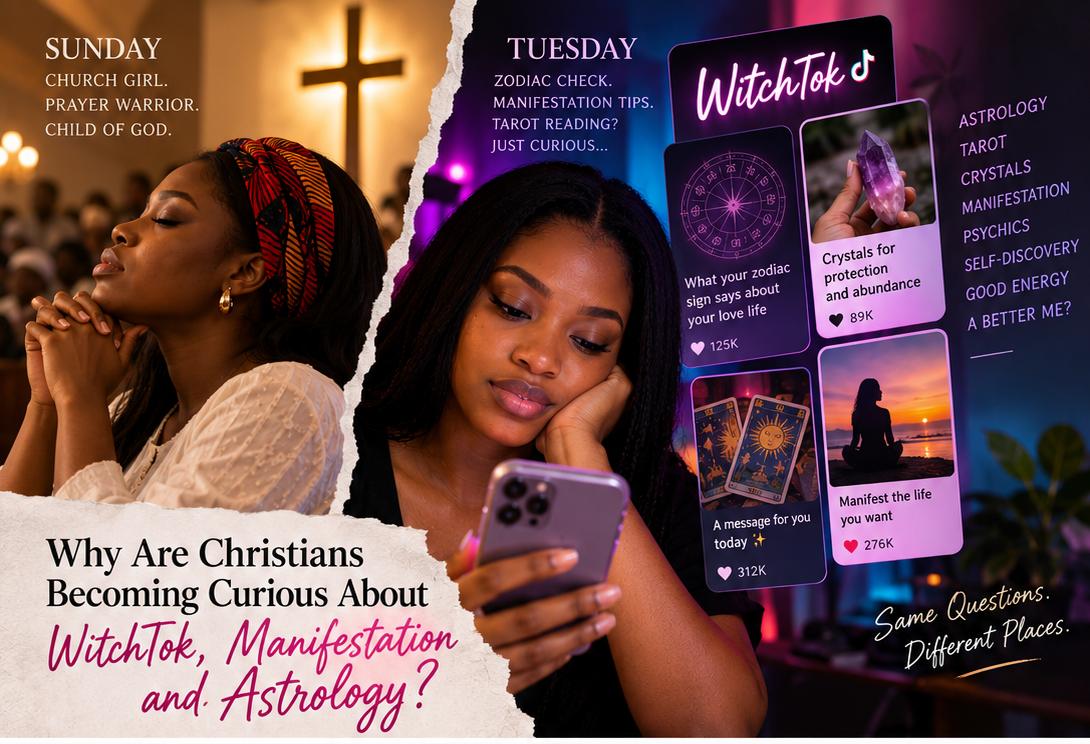
Why Are Christians Becoming Curious About WitchTok, Manifestation and Astrology?
Readers Rating :9.00
You can speak in tongues on Sunday, pray before bed on Monday, and still be checking your zodiac sign on Tuesday. It sounds contradictory. For many Nigerians, it is almost unthinkable. Nigeria is one of the world's deeply religious societies, with Christianity playing a major role in family life, culture and everyday conversation. Many Nigerians grow up hearing warnings about witchcraft, divination, astrology and other spiritual practices, yet open your phone today and you will find a very different conversation. Tarot readings are appearing on TikTok. Astrology accounts are explaining personality and relationships. Crystals are being marketed as tools for energy and healing. Manifestation videos promise that your thoughts, intentions and habits can help you attract the life you want.
And then there is WitchTok, what makes this particularly interesting is that some of the people consuming this content are not atheists or else people who have completely rejected Christianity, some identify as Christians. That creates a fascinating question: Why are Christians, particularly younger Christians, becoming curious about spiritual practices that their faith has traditionally warned them against?
The new spiritual marketplace
“WitchTok” is the informal name given to the huge collection of TikTok content centered around witchcraft, tarot, astrology, crystals, manifestation, spellwork and related spiritual practices. The remarkable thing is how ordinary it can look. There may be no mysterious ceremony or else dramatic ritual. Instead, there is a young woman explaining what your birth chart supposedly says about your personality. Someone else is demonstrating a manifestation routine, another creator is explaining which crystal to keep beside your bed, a tarot reader is offering a relationship reading. The content is often packaged as entertainment, lifestyle advice or else self-discovery, and because it lives on social media, it can reach millions of people without them deliberately searching for it. The algorithm does not ask whether you are Christian, it simply notices that you watched the video, then it gives you another.
Nigeria has a complicated relationship with spirituality This conversation becomes even more interesting in Nigeria. Nigerians are no strangers to spiritual explanations for everyday life. Prayer, prophecy, dreams, spiritual warfare and deliverance are familiar parts of Christian culture. At the same time, traditional African spiritual beliefs remain part of Nigeria's cultural history. So spirituality itself is not the difficult part, the question is which spiritual authority people trust?
A Nigerian Christian may reject traditional religious practices and strongly oppose witchcraft, yet become comfortable with astrology because it is presented as personality analysis. Someone may reject divination but watch tarot readings because they consider them entertainment. Another person may attend church regularly while practising manifestation because they understand it as positive thinking rather than a spiritual practice. The boundaries are becoming blurred.
Is this rebellion against Christianity? Perhaps sometimes, but that explanation does not tell the whole story. A young Christian who becomes interested in astrology or else manifestation may not be trying to abandon Christianity. They may be looking for answers, they may want to understand themselves, they may be anxious about their future, they may want guidance about relationships, they may be looking for healing after disappointment, or else they may simply be curious, and this is where the conversation becomes uncomfortable for the Church. Because if young people are finding spiritual answers elsewhere, Christians have to ask why. What are they searching for that they do not feel they are finding in church? Manifestation speaks directly to a generation that wants control.
Consider manifestation. Its appeal is easy to understand. Life can feel uncertain. Jobs are difficult to find. Relationships are complicated. The future can feel frightening. Manifestation culture offers a simple message:
Visualise what you want. Speak it. Believe it. Work towards it. Attract it.
Some versions are little more than motivational psychology. Others move into explicitly spiritual claims about the universe, energy and attracting desired outcomes. For someone who feels powerless, the message can be extremely attractive.
Christianity, however, presents a different framework. The Christian is not taught that the universe exists to fulfil their desires, christianity teaches prayer, obedience, dependence on God and acceptance that God's will may not always match human desire. That distinction is important. Astrology offers something else: identity Astrology has a different attraction. People want to understand themselves.
Am I emotional?
Why do I behave this way in relationships?
Why do I keep attracting the same kind of person?
Why do I struggle with certain personalities?
Astrology offers ready-made categories.
“You are a Scorpio.”
“You are a Leo.”
“You are a Pisces.”
Suddenly, complicated human behaviour has a neat explanation.
For a generation constantly thinking about identity, personality and relationships, that can be powerful. The problem for Christianity is that the source of identity is different, Christianity does not define a person's identity by their birth date or else zodiac sign, it defines identity through their relationship with God, and then there is the question of spiritual danger, Christians should not dismiss these concerns simply because some of the content looks harmless. Traditional Christian teaching has long rejected divination, occult practices and attempts to obtain supernatural knowledge outside God, that is why Christian leaders are concerned about the growing normalisation of these practices online.
The concern is not necessarily that every person who watches a tarot video will suddenly become involved in occultism, that would be an exaggerated claim. The concern is that repeated exposure can gradually make practices once considered incompatible with Christianity appear normal, harmless or else even fashionable. What was once viewed as spiritually dangerous can become “just content” and once something becomes normal, the barrier to participation becomes much lower.
But Christians should also resist panic. There is a temptation for churches to respond to every cultural trend with fear. That may not work. Telling young people, “Don't watch that,” without explaining why, can make the subject even more attractive. Curiosity does not disappear because adults become angry. In fact, it can become stronger. Young Christians need more than warnings, they need theological understanding, they need to know what Christianity teaches about spiritual authority, prayer, divination, identity, suffering and the future. Most importantly, they need to be able to ask difficult questions without feeling that asking the question itself makes them a bad Christian.
The real competition is not between Christianity and TikTok. It is between different answers to the same human questions.
Who am I?
Why am I here?
What does my future look like?
Why do bad things happen?
Can I change my life?
Is there something beyond what I can see?
Christianity has been answering these questions for centuries, but now it has to answer them in a world where a 60-second TikTok can offer an alternative explanation before a person has even opened their Bible, that changes the challenge. The Church cannot simply complain about the internet, it has to understand it, it has to understand what young people are watching, why they find it compelling and what emotional or else spiritual needs sit underneath the trend.
Perhaps the biggest question is not “Why WitchTok?” Perhaps the bigger question is: Why are people so hungry for spirituality in the first place? Technology has not killed the human desire for meaning. If anything, it has given that desire more places to go. A young Nigerian can attend church on Sunday morning, listen to a sermon about faith, return home and spend the evening watching astrology, manifestation and tarot content on TikTok.
That is the new reality, the answer cannot simply be outrage, Christians need discernment, they need honest conversations, and churches need to offer young people a faith that is intellectually serious, spiritually meaningful and capable of addressing the questions they are actually asking, because beneath the zodiac signs, crystals, tarot cards and manifestation videos is a question humanity has been asking for thousands of years:
“Is there something more to life, and where do I find it?”
The question is ancient, the feed is new, and Christianity now has to decide how it will speak into it.
Interesting thought Kaella.
Curiosity is a sign a healthy soul, because only the dead stop questioning things. But curiosity also needs safety. Over time, safety has been established through certain laws and principles—just like the laws that allow things to fly.
One book that has stood the test of time is the Bible, and I think one of the safest places to be curious is within the boundaries of Scripture.
Be curious, ask questions, seek understanding but stay within the confines of Scripture.
James O on: 18 Sep 2026
This is very interesting and I'll dig in deeper.
Nice article
on: 18 Sep 2026
Clap Claps
on: 18 Sep 2026
Clap Claps
Oghenekevwe Deke on: 16 Sep 2026
This is a topic that a lot of us are avoiding, and in typical Nigerian fashion, Avoiding it or else merely brushing it aside do not solve the problem.
The irony of this that these WitchTokers are doing fairly similar things to what our 'Traditional Religion' does, but the acepptance to both is different.
Anyways, my opinion on this is that maybe these Gen Z and Millineals doing this are doing it to reconnect with their 'African Identity'
Ola on: 16 Sep 2026
Bohemian is the new normal. Interesting but long read.
Ola on: 16 Sep 2026
Bohemian is the new normal. Interesting but long read.